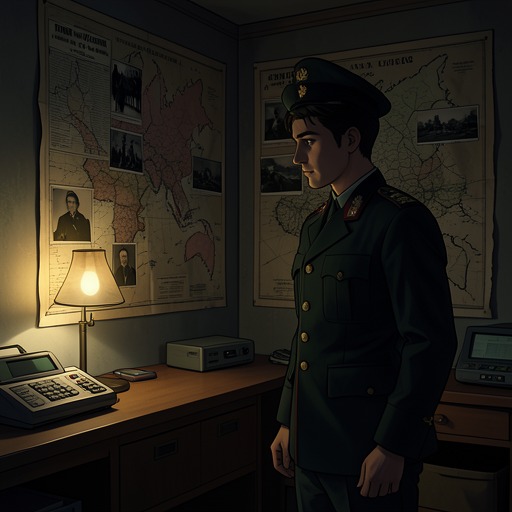
The guardianship of Peter Augustus Duchene by Vilna Lutz
The Magician's ElephantThe guardianship of Peter Augustus Duchene by Vilna Lutz is a relationship formed in the aftermath of Peter’s parents’ deaths and broken open by Lutz’s concealment of what happened to Peter’s sister, Adele. Lutz gives Peter a home and raises him according to a soldier’s discipline, but his protective intentions cannot erase the harm of making Peter believe Adele was dead. The conflict ultimately redirects Peter from the future Lutz planned toward the promise Peter made to his mother: to care for his sister.
Origins in Loss and Soldiering
Peter’s dependence on Lutz begins with the death of his father, a soldier who had served alongside Lutz. After the father died on the battlefield, Lutz came to the family home to deliver the news. Peter later explains that his mother went into labor when she heard it; Adele was born, and their mother died. Before her death, Peter promised to watch over the baby. Instead, a midwife took Adele away, and Lutz took Peter with him to teach him to become a soldier.
The relationship has both a practical and an emotional basis: Lutz is Peter’s guardian, but he is also the surviving friend of Peter’s father and the adult who assumes responsibility for the boy. The arrangement is nevertheless shaped by Lutz’s own knowledge and values. He understands soldiering, as he later admits, but says he did not know how to care for an infant. His guardianship therefore protects Peter while also directing him toward a role built around military discipline rather than the family duty Peter had chosen for himself.
Daily Authority and Peter’s Conscience
The unequal terms of the relationship appear in small, concrete details. In Baltese, Lutz sends Peter to the market to buy fish and bread with a single florit that belongs to the guardian, not the boy. Peter is ten years old and describes himself as training to become a soldier, brave and true. Even when compelled by his need to learn whether his sister is alive, he worries that spending the coin without permission will require him to lie to Lutz. He finally goes to the fortuneteller, resolving that he will not conceal what he has done and will remain at least partly honourable.
The attic room at Apartments Polonaise also places Lutz’s authority within a domestic routine marked by military work. When Peter returns from the market, Lutz waits by the window with battle-plan papers on his lap and a candle lit. He calls Peter “Private Duchene” and points out that he has returned late and empty-handed. The address makes their household relationship sound like a chain of command: Peter is treated as a subordinate even at the moment he is trying to find out what his guardian has hidden from him.
The Secret and the Breach of Trust
The fortuneteller’s answer gives Peter grounds to believe that Adele lives and that an elephant will lead him to her. He confronts Lutz with that news, saying, “She lives,” and makes clear that the unexpected arrival of an elephant has made him believe the fortuneteller rather than his guardian. Lutz initially asks who is alive; Peter answers that it is his sister. The revelation turns a long-standing uncertainty into a direct accusation against the person on whom Peter depends.
Lutz admits that the midwife took Adele away because she considered the baby too small and too delicate to entrust to him. Peter points out that Lutz repeatedly told him the baby had died. Lutz tries to distinguish this from a lie, describing it as scientific conjecture: babies without their mothers might not survive, and Adele was very small. He also says he concealed the truth to protect Peter from the pain of knowing, and that he cared for the boy and admired his father. His explanation reveals a sincere protective rationale alongside a serious failure: rather than let Peter know what was uncertain, Lutz made uncertainty sound like death.
Peter’s Rejection of the Soldier’s Future
Lutz’s confession does not restore Peter’s trust. Peter says he is done talking, plans to go to the elephant and find his sister, and will be done with Lutz as well. He also rejects soldiering as useless and pointless. When Lutz urges him to think of his father, Peter answers that he is doing precisely that. The exchange exposes the difference between them: Lutz invokes the father’s memory to defend the soldier’s path, while Peter invokes it in connection with his promise to protect Adele.
Peter’s account to Gloria Matienne clarifies how those commitments diverged. Lutz had been his father’s friend and had taken him away to train him after Adele was removed by the midwife. But Peter’s original promise to his mother had not disappeared; it had been frustrated by circumstances and by his ignorance of Adele’s survival. Once he learns the truth, he acts on that promise rather than on the identity Lutz has prepared for him.
Care, Separation, and the Relationship’s Meaning
The later reunion between Peter and Adele completes the contrast between Lutz’s guardianship and Peter’s chosen responsibility. In the snow, Peter picks up his sister because it is cold and her feet are bare, and because he had promised their mother long ago that he would always take care of her. The concrete act of protecting Adele answers the promise that began with her birth. Lutz had raised Peter after a family bereavement, but his concealment prevented Peter from fulfilling that promise until the truth came to light.
The novel does not make Lutz’s stated care meaningless: he says he acted to spare Peter pain, and his sorrow at the confrontation is visible. But it distinguishes care from the authority to decide what another person is allowed to know. Peter’s break with Lutz follows from that distinction. The guardianship gives Peter shelter and direction, yet its most consequential act of protection becomes a source of estrangement when Lutz substitutes his own judgment for Peter’s right to know about his sister. Peter’s eventual choice to care for Adele shows the bond to his parents surviving the failure of his guardian’s account of the past.